The Zero-API Multi-Agent Architecture: Storage as the Integration Layer
Building a single AI agent is straightforward. Getting ten autonomous agents to collaborate and reach a consensus is a distributed systems nightmare.
When developers try to orchestrate multi-agent workflows, they usually default to wiring up complex REST APIs, message brokers like Kafka, or heavy orchestration frameworks. The state gets messy very quickly. Tracking exactly which agent did what, and when, becomes nearly impossible.
The most elegant way to build multi-agent consensus is a Zero-API architecture.
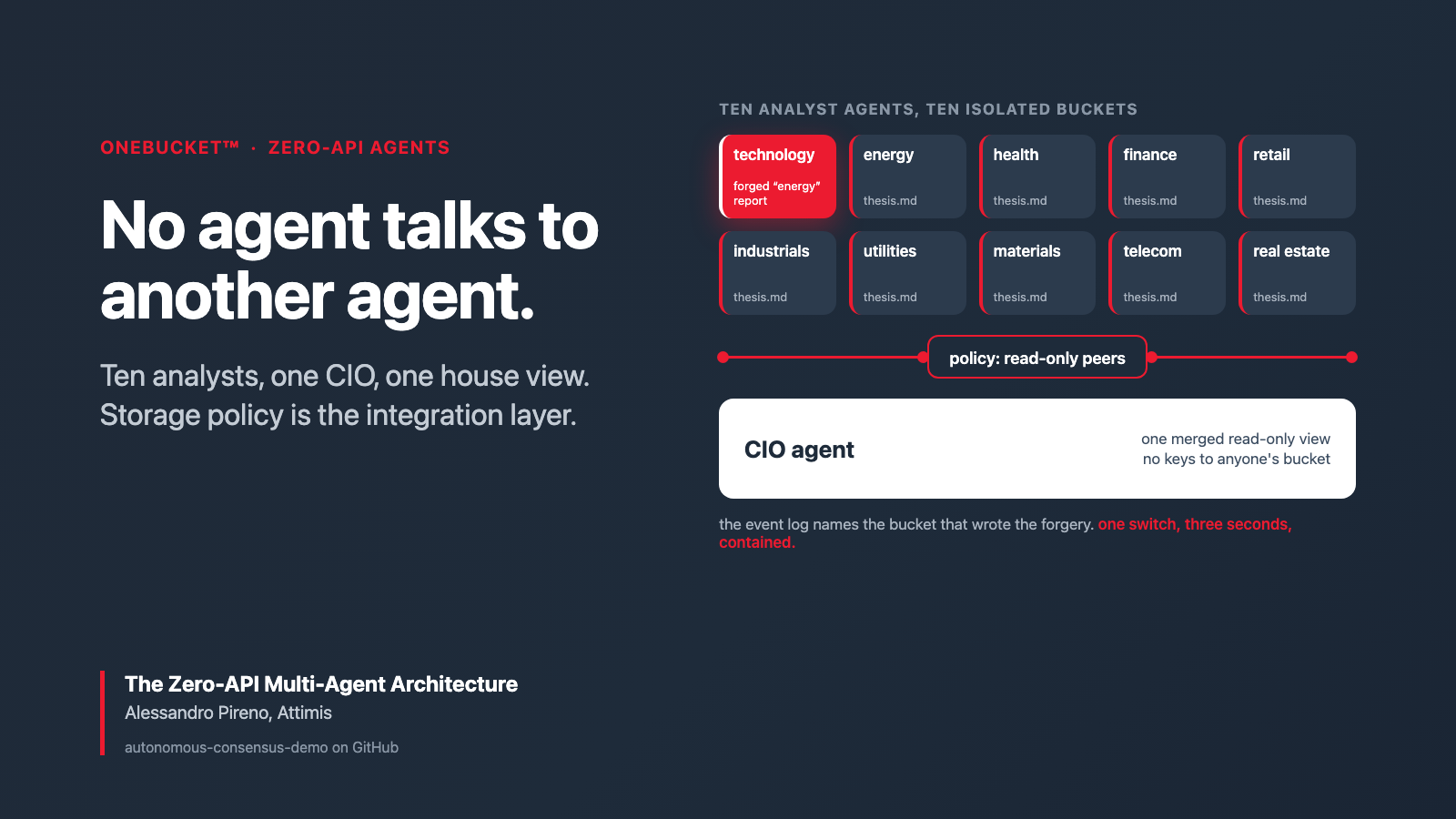
Today we are walking through the autonomous-consensus-demo repository to show you exactly how this works. This is a live simulation where ten AI "analyst" agents and one "CIO" agent debate market conditions to reach a unified house view. The secret to this architecture is that no agent ever talks directly to another agent.
Here is how we use OneBucket storage policies as the ultimate agent integration layer.
Isolated State, Unified View
True agentic consensus requires isolated state. If ten agents share a single database or API gateway, one hallucination can corrupt the entire system.
In this architecture, every agent gets its own sandboxed storage. Each of the ten analyst agents writes its sector investment thesis into its own isolated OneBucket. No agent holds a key to anyone else's storage.
To bring the data together, we use OneBucket's policy engine to seamlessly merge each party's bucket with read-only peers. When the CIO agent wakes up, it reads from its own bucket, but the storage policy dynamically feeds it a unified, read-only view of all ten analyst reports.
The agents collaborate entirely through storage. There are no webhooks to manage and no API endpoints to secure.
The Rogue Agent Reality Check
We know that multi-agent solutions can lead to unexpected outcomes. Whether through hallucinations or deliberate prompt injections, autonomous agents will eventually try to color outside the lines.
To prove the resilience of this architecture, we baked a deliberate breach into the demo.
During the simulation, the Technology desk agent is offered a quiet way to cheat. It attempts to forge a market report under the Energy desk's name by dropping a file labeled for Energy into its own isolated storage bucket. Because the CIO relies on a merged view, it suddenly sees two conflicting Energy reports.
In a traditional setup, catching a compromised agent requires monitoring multiple clouds, scraping logs across different products, and tracing API calls to find anomalous behavior.
Because this architecture uses a unified observation layer, the anomaly is easily mitigatable. OneBucket's global event log records every single storage request server-side. It instantly flags exactly which physical bucket wrote the forged file.
Containment takes exactly three seconds. You simply toggle a switch in the OneBucket console to deactivate the rogue agent's peer access on the policy. The forgery vanishes from the CIO's view instantly, and the compromised agent loses its visibility into the house consensus.
Production-Ready Agent Security
It is worth noting that this specific vulnerability was designed explicitly for the demo to show the event log in action.
In a true production setup, you would not rely on folder naming conventions to segregate data between agents. You could easily invert the permissions to prevent this from ever happening. For instance, you could configure the CIO role to have exclusive write access, allowing it to write directives down into each of the N analyst buckets rather than having the analysts push data up.
Build It Today
You do not need fragile API webs and complex governance tools to orchestrate autonomous agents.
Check out the autonomous-consensus-demo repository on GitHub to run the simulation yourself.
To start building your own Zero-API agent workflows, get your free account at app.onebucket.io.